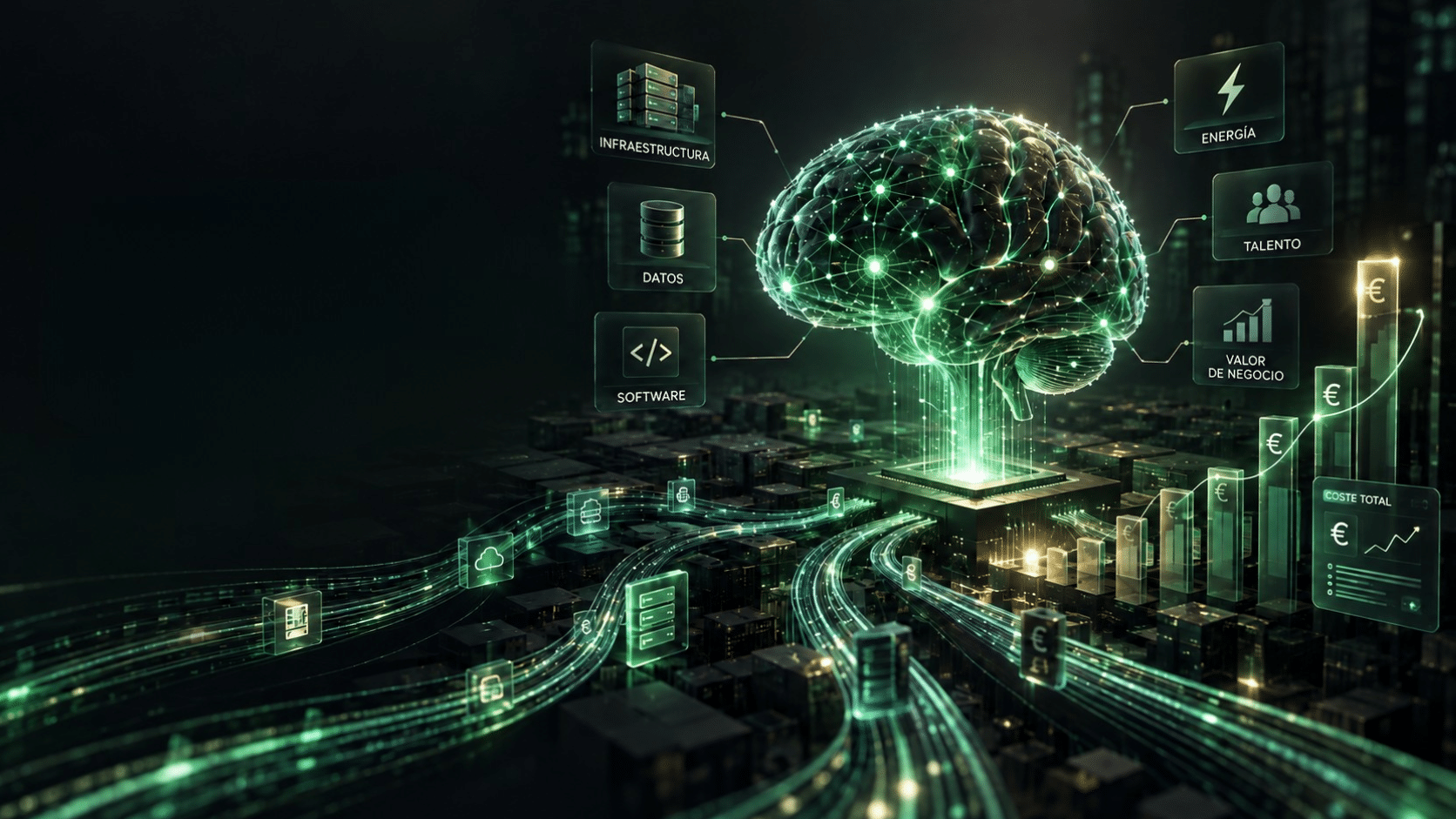
The possibilities are enormous. But so are the resources needed to make them a reality. The problem is that it's not always easy to know in advance how much it will cost to use a solution. Artificial Intelligence. Unlike other technologies with more predictable costs, many AI services incorporate usage-based payment models. In token-based APIs, for example, the cost can depend on the model used, the amount of input sent, the generated response, and, in certain models, other types of tokens used during processing. Therefore, two seemingly similar operations do not necessarily consume exactly the same resources or generate the same cost.
This uncertainty increases when AI moves beyond occasional use and begins to be integrated into corporate processes. An agent may need to make multiple calls to a model to complete a single task, consult information, analyze documents, or interact with other systems. Multiplied by hundreds or thousands of operations and users, an initially small consumption can become a significant expense. Therefore, estimating the cost of AI requires considering not only the cost of implementation but also the cost of its recurring use at scale.
In addition to this variable consumption, there are the more traditional costs of any technological implementation: infrastructure, licenses, development, integration, maintenance, storage, and computing capacity. And there is also a less visible cost related to the environmental impact of Artificial Intelligence: energy and water consumption, and the physical resources needed to sustain all that processing capacity.
Let's not panic; this doesn't mean we should use less AI. It means that, as its use increases, it becomes even more important to use it where it can truly generate value and to design each solution in proportion to the need it aims to address.
AI doesn't happen in the cloud: it needs real infrastructure
Talking about Artificial Intelligence can convey a certain sense of intangibility. You write an instruction, receive a response, and everything seems to happen instantly. Behind that process, however, lies a significant technological infrastructure.
Models require data centers, high-performance processors, networks, storage systems, and cooling. All of this requires electricity and other physical resources both during model training and subsequently, each time the models are used.
The International Energy Agency It estimates that global electricity consumption by data centers could increase from approximately 415 TWh in 2024 to around 950 TWh in 2030. This more than doubles in just six years. The IEA itself identifies Artificial Intelligence as one of the main drivers of this growth and predicts that consumption by data centers specifically focused on AI will increase even faster.
The environmental cost goes beyond electricity
The energy consumption of Artificial Intelligence is probably the most well-known aspect of its environmental impact, but it is not the only one. Data centers need cooling systems to keep the equipment that processes enormous amounts of information running. In many cases, these systems also require significant quantities of water.
He MIT It points out that the environmental impact of generative AI should be analyzed considering not only the electricity used to train and run models, but also the water consumption needed to cool the facilities and the impact derived from manufacturing and transporting the hardware used.
Added to all this is the source of the electricity. According to the IEA (International Energy Agency), Approximately half of the additional growth in electricity demand for data centers until 2035 could be met by renewable energy sources, although other sources such as natural gas, coal, and nuclear power will continue to play a significant role depending on the region. Therefore, discussing AI sustainability is not simply about measuring how many queries a model performs. It involves analyzing the entire technological system that enables those queries.
There is also an economic cost that increases with use
Computing capacity is not free either. Every interaction with a model consumes processing resources, and as an organization expands the number of users, automates more processes, or incorporates agents capable of performing multiple tasks autonomously, that consumption can multiply.
In addition to the direct costs associated with using the models, consideration must be given to the necessary infrastructure and computing power, data storage and processing, licenses and platforms, the development and customization of the solutions, and their integration with corporate systems. Furthermore, aspects such as cybersecurity and information protection, tool maintenance and updates, operational monitoring, and the training required for teams to use them correctly must also be factored in.
Therefore, evaluating only the initial price of a tool provides an incomplete view of the true cost of implementing and scaling Artificial Intelligence. The real cost emerges when AI is integrated into continuously running processes and begins to be used at scale.
Not all problems require the same AI
Precisely because resources are not unlimited, one of the most important decisions is determining which technology is needed to solve each problem, since not all use cases require the most advanced models. One process can be solved through traditional automation. Another will need a specialized model. Another may benefit from generative AI, and yet another may justify the use of an agent capable of interacting with different applications.
Using a more complex solution than necessary can mean higher consumption, higher costs, greater maintenance difficulty, and in some cases, more risk without an equivalent benefit.
The value must justify the resources used.
All of the points discussed in the preceding paragraphs lead to a fundamental question: before implementing AI, it's essential to know what we want to achieve with it. Reducing processing times, improving decision-making, automating repetitive tasks, increasing team capacity, personalizing services, detecting anomalies, or creating a new customer experience are all concrete objectives.
When a use case is well-defined, it becomes much easier to assess the necessary resources and whether they are proportionate to the expected outcome. For example, a process that occurs thousands of times a month can perfectly justify a solution requiring a considerable investment if it significantly reduces time, errors, or costs. Conversely, automating a sporadic, low-impact task with complex technology may not make sense, even if it is technically possible.
From experimentation to responsible use
During the early years of generative AI adoption, experimentation had enormous value in itself. It was necessary to understand what the technology could do.
Now a second stage begins. As AI is incorporated into enterprise applications and begins to be used routinely, organizations need to move from testing possibilities to deciding what truly deserves to be deployed to production. This involves prioritizing use cases, estimating their impact, analyzing data needs, selecting technologies, establishing metrics, and considering issues such as security, privacy, regulation, and sustainability from the outset.
When discussing responsible Artificial Intelligence, the conversation often focuses on issues such as bias, privacy, transparency, human oversight, and regulatory compliance. But there is another dimension that will gain importance as the use of these technologies increases: resource efficiency. If millions of operations are going to rely progressively on AI models, deciding when to use them, which model to use, and how to design each solution will have both economic and environmental consequences.
Clearly, all of this can be overwhelming, too many things to consider. That's why having experts on board allows you to transform that need for guidance into a realistic roadmap: identifying and prioritizing the use cases with the greatest potential, defining a governance model that establishes responsibilities, controls, and boundaries, and designing an implementation that takes into account technology, data, security, integration, adoption, and scalability.
Truly leveraging Artificial Intelligence depends not only on choosing a good tool, but also on knowing where to apply it, how to govern it, and how to integrate it into the organization so that it generates value in a sustainable and responsible way.