
Solutions
Inactive
Company
Technology Partnerships
- AWS
- Google Cloud
- Microsoft
- Salesforce
- SAP
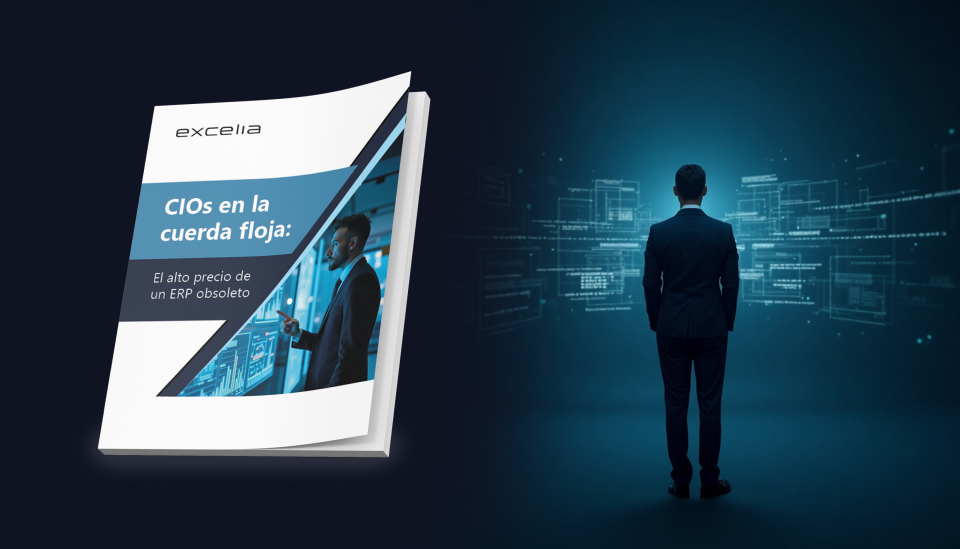
Madrid, September 24, 2025 — CIOs face increasing pressure to innovate and respond with agility, but outdated ERPs act as a brake that limits competitiveness and security. Although many companies invest in AI or automation, these technologies lose value if they rely on obsolete systems whose maintenance, as indicated Microsoft, can consume up to 90% of the IT budget. Excelia, a Spanish consulting, technology and professional services firm, has launched its new report “CIOs on the ropes: the high price of an obsolete ERP”, in which he points out the 8 main symptoms that a company can observe to detect that it needs to modernize its ERP.
1- Complicated or non-existent updates: If applying patches involves long and expensive projects, or the manufacturer no longer offers support, the system becomes a source of risk.
2- Poor integration: It is complex or impossible to connect the ERP with modern solutions such as CRM, advanced analytics, e-commerce or mobile apps.
3- Manual and inefficient processes: Activities that should be automated still depend on spreadsheets, duplication of information, or manual work.
4- Limited mobility and access: The lack of a cloud version, remote access, or usability on mobile devices restricts operational flexibility.
5- Unreliable or delayed information: Reports arrive late, incomplete, or with inaccurate data, hindering real-time decision-making.
6- High maintenance costs: Maintaining the infrastructure, paying for specialized support, or resolving incidents increases expenses year after year.
7- Poor user experience: Unintuitive, rigid interfaces that are far removed from modern collaboration generate resistance among teams.
8- Lack of scalability: The ERP does not keep pace with the company's growth or adapt quickly to new lines of business, subsidiaries, or regulatory changes.
What steps should be taken to modernize the ERP?
ERP modernization can be a planned and controlled process if approached strategically: begin with a diagnostic assessment of critical systems, identify risks and limitations, prioritize high-impact updates, and implement new technologies where they offer the greatest return. Implementing changes in phases, ensuring compatibility, measuring results, and managing internal adoption with clear communication and training are key steps to minimizing risks. Furthermore, having a specialized partner helps guide the process, providing experience and knowledge to ensure that every technology investment generates real value.
Once this modernization is consolidated, the next natural step will be the incorporation of Artificial Intelligence agents, transforming the ERP into a proactive assistant capable of anticipating needs, optimizing operations and freeing teams from repetitive tasks.
“ERP systems have been essential for integrating processes and providing control to organizations, but even the most advanced still require a significant amount of human intervention. Artificial Intelligence agents are the next step: they analyze data, anticipate problems, and enable conversational interactions, transforming the ERP into a proactive assistant that optimizes operations and frees teams from repetitive tasks.”, he comments Juan Pablo Plaza, Business Applications Managing Director from excelia, which adds: “For these innovations to have a real impact, it is key to have a partner like Excelia in their implementation, which brings experience and knowledge to support companies in modernizing their systems and ensuring that every technological investment translates into efficiency, agility and sustainable growth.”.
Excelia offers solutions for Business Applications Designed to modernize systems in a scalable and secure manner, these solutions are based on three pillars: progressive modernization of ERP systems toward modular architectures, intelligent integration that connects critical applications to achieve a unified, real-time view, and automation with advanced analytics to optimize processes and make data-driven decisions. All of this is complemented by technology governance and change management methodologies to ensure a smooth transition and transform systems into engines of continuous transformation.