Thanks to this approach, many companies have made great strides in streamlining reporting, dashboards, analytics, planning, and key performance indicator (KPI) monitoring. They can now understand what's happening in their operations, how their results are evolving, and where deviations are occurring. But this model has already begun to show its limitations.
Having data doesn't always mean having context. In many organizations, the information is available, but teams still spend too much time cross-referencing sources, interpreting results, and turning data into concrete actions. Data explains part of reality, but it doesn't always provide the recommendation, the priority, or the next step on its own.
This is where the concept of the Frontier Enterprise comes from. It's an organizational model that evolves from Data Driven to AI Driven: from using data to understand the business to integrating it. Artificial Intelligence to interpret the context, anticipate scenarios, generate recommendations, and activate decisions with greater agility.
What is a Frontier Company?
A Frontier Company is an organization that integrates Artificial Intelligence across its entire operating model. It doesn't use it as an isolated tool or a one-off solution for each department, but rather as a capability connected to processes, teams, and decisions.
Microsoft This type of organization is defined as companies driven by on-demand intelligence and structured around hybrid teams of people and AI agents. In this evolution, AI begins as an individual assistant, then integrates into teams, and finally participates in entire processes under human direction and supervision. The key difference lies in the fact that Frontier Enterprises don't simply add AI to existing processes, but rather redefine how work should function when intelligence can be available at every workflow, every decision, and every area of the business.
From data to context
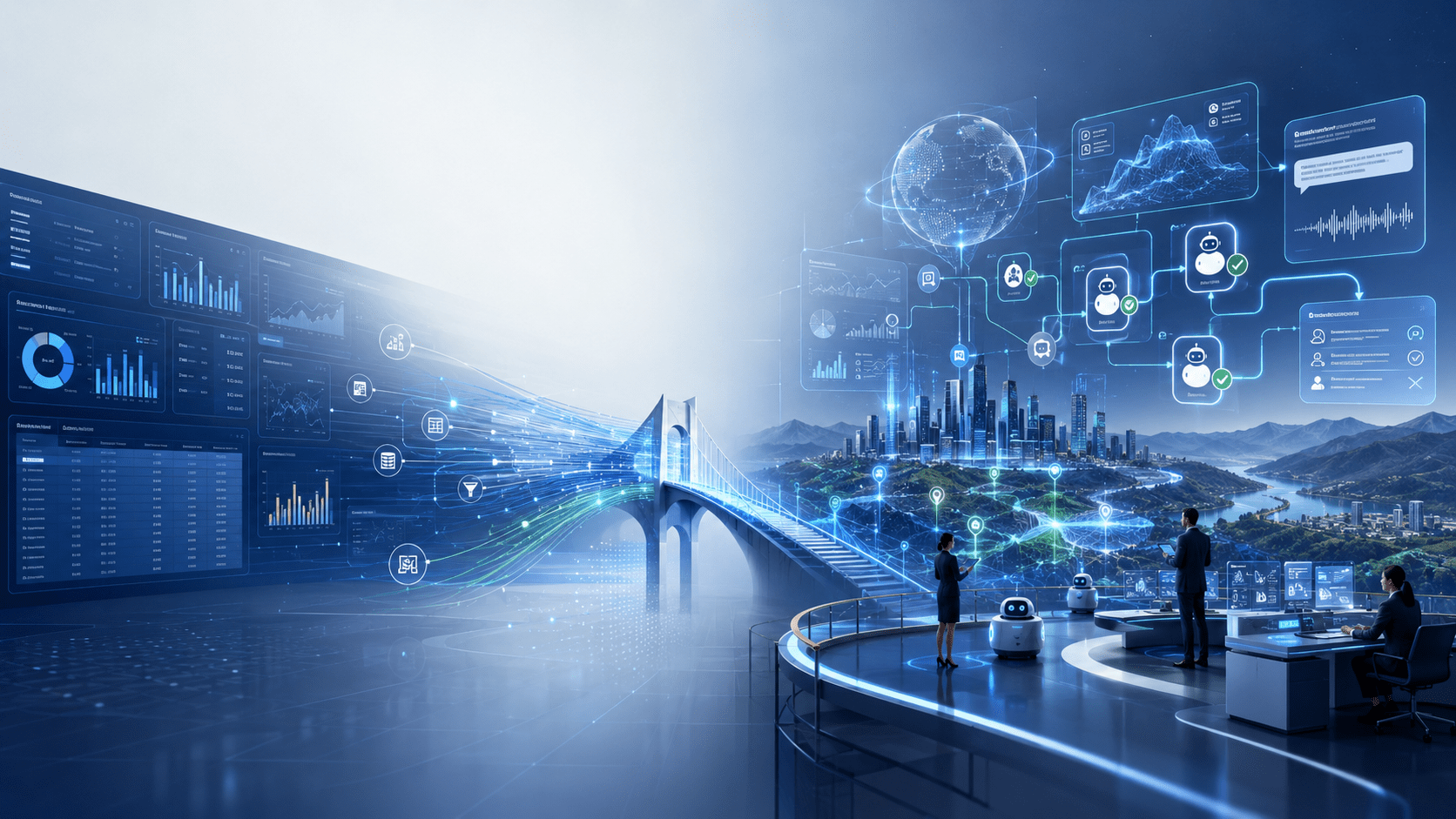
Of course, making the leap from a data-driven model to an AI-driven approach doesn't mean abandoning data altogether. It means taking it further. Many companies already have dashboards, reporting, and analytics to get the most out of their data. They can see what has happened at any given moment, which indicators are performing better or worse, and where deviations appear. However, these models still have limitations, as they rely solely on internal data, require manual analysis, incorporate little external context, and don't always help prioritize the next action. This is where the concept of the Decision Gap comes in, which refers to the gap between having information and the ability to transform it into useful, contextualized, and action-oriented decisions.
A traditional dashboard might show a budget deviation or a drop in margin, but it almost never explains why it's happening, how it compares to the market, or what alternatives management should consider. Frontier is moving toward an AI-Driven Decisioning model that goes beyond simply reading data and provides a 360-degree view of the business, connecting context, benchmarks, natural language, automated insights, and practical recommendations to transform information into more comprehensive and actionable decisions.
AI agents integrated into workflows
One of the most defining elements of a Frontier Enterprise is the integration of AI agents into workflows. Unlike a purely conversational tool, such as ChatGPT, an AI agent doesn't simply answer questions: it can intervene in a specific workflow, connect with corporate systems, and collaborate with people to achieve a goal. The real transformation occurs when these agents connect with each other in multi-agent systems, where each agent takes on a specialized part of the process and collaborates with others to complete a full workflow, from initial analysis to recommendation or supervised execution.
This drastically redefines the relationship between human talent and technology. First, each professional can rely on an AI assistant to work better and faster. Then, these agents are integrated into teams and take on specific tasks. As a result, these agents can participate in more comprehensive processes, always with traceability, boundaries, and oversight. Welcome to hybrid teams.
The point is not that Artificial Intelligence will replace people, but rather that the value of these agents lies in expanding their capabilities. Human capacity shifts towards judgment, oversight, creativity, customer relations, and decision-making.
Scaling AI with control
A frontier company must be built from the ground up. Scaling AI demands method, governance, and accountability. Organizations that want to move toward this model should start with low-risk internal use cases, define clear limits of autonomy, establish role-based access controls, ensure traceability, and maintain human oversight of sensitive decisions. They must also prepare their data, architecture, organizational culture, and security criteria before scaling. When informal automation grows unchecked, risks emerge, such as disconnected tools, unsupervised data use, lack of traceability, and poorly auditable decisions.
He European Regulation on Artificial Intelligence This need for control is reinforced through a risk-based approach, focusing on transparency, human oversight, data governance, and documentation of AI systems. Therefore, moving towards a Frontier Enterprise requires a balance between innovating securely, maintaining traceability, and never losing sight of the business vision.
The company that learns the fastest
Becoming a Frontier Company is a different way of understanding the organization as a whole. It means moving from isolated Artificial Intelligence initiatives to an operational model where AI is integrated into processes, teams, and decisions. It consists of combining agents with human judgment, automation with governance, data with context, and efficiency with responsibility.
Companies that move forward first will be better prepared to respond to market changes, optimize resources, anticipate risks, and generate new growth opportunities. The future of business will be shaped by how well companies connect talent, technology, and data to make better decisions, operate more efficiently, and learn faster.