
Solutions
Inactive
Company
Technology Partnerships
- AWS
- Google Cloud
- Microsoft
- Salesforce
- SAP
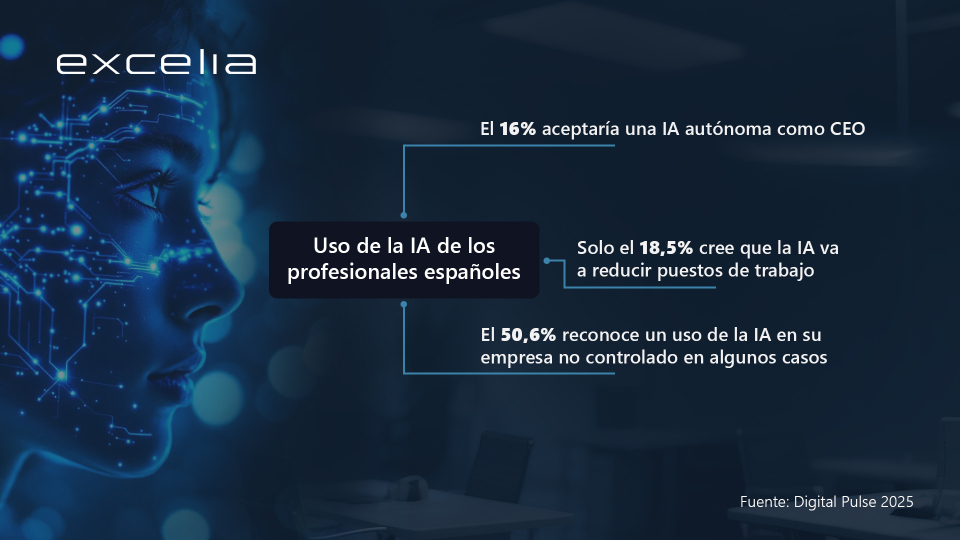
With the rise of Artificial Intelligence, many are beginning to wonder how it will affect the professional world in the not-too-distant future. This technology allows for improved decision-making in many cases, but to what extent? According to the report Digital Pulse 2025: Digital Maturity Barometer of Spanish Companies of Excelia, According to a Spanish consulting, technology and professional services firm, 16.11% of Spanish professionals would be willing to work under fully autonomous AI leadership, provided it demonstrated better results than a human leader.
This report, based on a survey of more than 400 professionals from Spanish companies of different sizes and sectors, highlights that, despite this, for 44.41% of respondents, people are still indispensable when it comes to leading a business, while 39.51% would only accept AI management if it were under human supervision.
Control in the use of AI
The reality is that Artificial Intelligence has already become another tool in the daily lives of Spanish professionals. The problem arises when studying the level of control companies have over its use. In this regard, the Excelia study reveals that only 38.31% of respondents say that the use of AI tools in their company is fully supervised by the IT department, while the majority (50.61%) acknowledge unofficial use by some teams or specific individuals. 11.11% indicate that the use of AI by employees without control from their organizations is widespread.
Impact of Artificial Intelligence on Employment
Faced with the perennial question of whether the AI revolution will lead to job losses, 45.71% of professionals consider it simply another tool that will enhance their skills, ruling out staff reductions. Meanwhile, 35.81% believe that, although it could replace some functions, it will actually create a need to hire new, more specialized professionals, while 18.51% think its implementation will have a direct effect on cost reduction through staff decreases.
“Artificial intelligence is transforming the way companies make decisions, but its true value depends on the human ability to interpret, monitor, and guide it toward specific objectives. Technology alone does not guarantee efficiency or success: it is the judgment, ethics, and strategic vision of people that make AI a reliable and productive ally.”, points out Antonio Cerdán, Hyperautomation Managing Director at Excelia, which adds: “For this reason, its implementation cannot be approached haphazardly. Organizations need a clear roadmap and a framework of guidelines that ensure consistent, ethical use aligned with the business strategy. Only in this way can AI unleash its full potential, driving innovation and competitiveness sustainably.”.
With over 25 years of experience, Excelia supports organizations on their journey toward digital transformation and international expansion, offering technology-based solutions and services. Among its areas of expertise are the implementations of Artificial Intelligence, Designed to integrate this technology in a planned, ethical manner, aligned with business strategy, their approach focuses on innovation and the adoption of advanced tools as drivers of sustainable growth. The company boasts a global network of over 300 specialized professionals who combine international perspective with local expertise, committed to providing solutions tailored to each client's needs.